

Anti-Bullying Week in Early Years: How Nurseries Can Break the Silence
Anti-Bullying Week in early years settings runs from Monday 16 to Friday 20 November 2026. This year's theme, Break the Silence, asks children, families and practitioners across the UK to talk openly about bullying rather than let it go unspoken. However, nurseries might assume this campaign belongs to primary and secondary schools. In reality, the habits it targets - exclusion, unkindness and power imbalances between children - often start much earlier than that.
What is Anti-Bullying Week 2026?
The Anti-Bullying Alliance, part of the National Children's Bureau, organises Anti-Bullying Week every year. In 2026, it runs from 16 to 20 November, and the theme, Break the Silence, came from conversations with more than 200 children and young people. Many of them described the silence that surrounds bullying and the barriers that stop young people from asking for help.
The week opens with Odd Socks Day on Monday 16 November. Children, staff and families wear mismatched socks to celebrate what makes everyone different. As a result, it is a simple, visual way to start a conversation about kindness before the week's deeper themes unfold.
The scale of the issue makes the campaign matter. Research highlighted by the Anti-Bullying Alliance shows that more than 1 in 5 children report being bullied each year. That figure covers school-age children specifically, but it points to a pattern that early years practitioners are well placed to interrupt before it takes hold. You can read the full Preventing and Tackling Bullying guidance on GOV.UK for the wider policy context.
Why bullying prevention starts in the early years
Personal, Social and Emotional Development sits at the heart of the EYFS for good reason. This is where children learn to name their feelings, take turns, resolve disagreements and understand how their actions affect others. Nobody arrives at nursery already knowing how to share a favourite toy or include a child who looks or sounds different from them. Instead, practitioners teach it, day by day, through modelling and gentle correction.
Children who never learn these skills carry the gap with them into reception and beyond. A 3-year-old who repeatedly excludes the same child from play, or who has learned that grabbing gets faster results than asking, is rehearsing patterns that get harder to shift the longer they go unaddressed. Anti-Bullying Week in early years settings gives you a natural prompt to check those patterns are being caught early.
Recognising unkind behaviour in under-fives
What this can look like day to day
Bullying in a nursery rarely looks like the playground scenes most adults picture.
Instead, it shows up as one child consistently telling another "you can't play with us", as a favourite construction toy taken from the same child every single day, or as a group of 3-year-olds who giggle and turn away whenever a particular peer approaches.
Spotting the difference between conflict and bullying
Not every squabble is bullying, and treating it that way can do more harm than good. The Anti-Bullying Alliance defines bullying as behaviour that is repeated, intentional and involves an imbalance of power. A one-off disagreement over a toy, resolved with adult support and a shared apology, is ordinary early years conflict. A pattern that targets the same child, repeatedly, with no resolution, is something your team needs a clear plan for.
Practical activities for Anti-Bullying Week in early years settings
You don't need an elaborate programme to mark the week meaningfully. A handful of well-chosen activities, repeated with warmth, will do more than a single big assembly.
- Odd Socks Day, Monday 16 November. Ask children and families to wear odd socks and talk about what makes each of us unique.
- Feelings check-in circle time. Use picture cards so children who cannot yet name emotions in words still have a way to show how they feel.
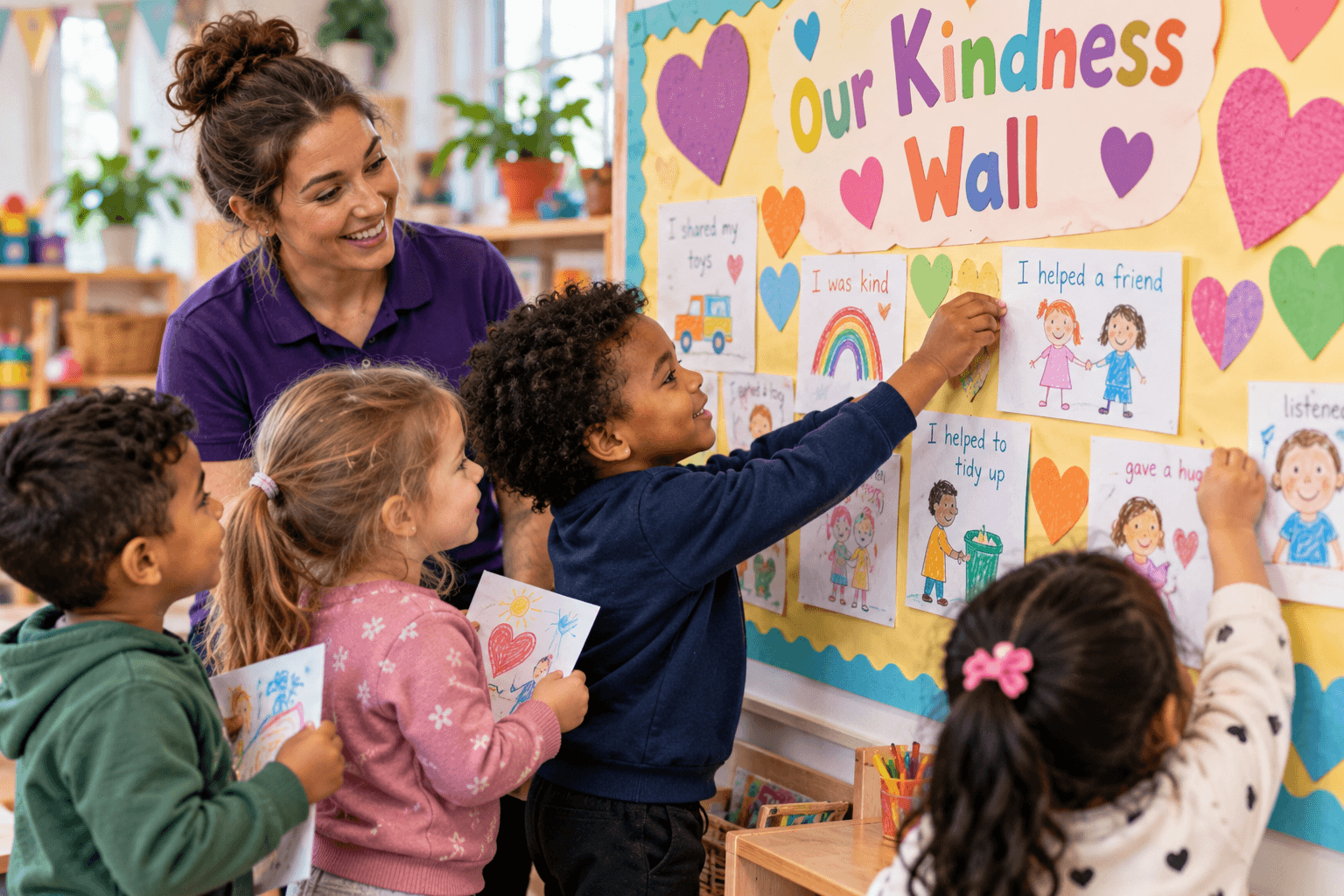
- A kindness wall. Younger children can draw a picture of something kind they did or saw, rather than writing a sentence.
- Puppet role play. Puppets model asking a friend to join in, or asking an adult for help when play goes wrong, in a way that feels safe and low pressure.
- Share the Anti-Bullying Alliance's Parent and Carer Pack. It gives families simple ways to continue the conversation at home.

Talking to parents about Break the Silence
Above all, a short note home goes a long way. Parents want to know that unkind behaviour gets noticed and handled, not brushed aside because "they're only three". Use your newsletter or parent app to explain the week's theme in plain terms, share 1 or 2 of the activities above, and invite questions. If a parent has previously raised a concern about their child being excluded or unsettled by another child's behaviour, this is a good moment to follow up and show them what your setting is doing about it.
Supporting your team to respond with confidence
Marking Anti-Bullying Week in early years settings works best as a spotlight on practice that runs all year, not a one-off event. That depends on practitioners feeling confident spotting early signs of exclusion, responding consistently, and knowing when a pattern needs escalating through your safeguarding procedures. Regular training keeps that confidence current, particularly for newer staff who have not yet built up years of experience reading a room full of 3 and 4-year-olds.
If your team would benefit from extra support here, our childcare courses cover behaviour management and safeguarding as part of a broader qualification pathway, so staff build these skills alongside everything else they need for the role.
Keeping the conversation going after the week ends
Anti-Bullying Week in early years settings works best as a starting point rather than a finish line. Revisit the kindness wall in December, ask children what they remember from Odd Socks Day, and keep using the same simple language about feelings and fairness in everyday circle time. The habits your children build this November are the ones that carry into their next room, and eventually into school.
Bullying prevention in the early years is quiet, patient work. It rarely makes headlines the way it does in secondary schools, but the conversations you start this November, however small, help build children who grow up ready to speak up rather than stay silent. For more seasonal ideas for your setting, take a look at the Parenta blog.
Want to give your team more confidence handling behaviour and safeguarding conversations like these? Get in touch with our friendly team or call us on 0800 002 9242 to find out more about our childcare courses.
